Building a Life in
Germany Over Time
Your 1st residence title to long-term settlement, career progression, family stability, and citizenship, Germany is designed for people who plan ahead.
Germany Rewards Integration, Not Speed
The system is predictable when you treat it like a multi-year plan.
Germany is not structured for “quick outcomes”. It is a rules-based society where long-term stability is earned through documented skills, consistent employment, language progression, and compliance with administrative processes. The trade-off is powerful: strong labour protections, high predictability, and clearly defined pathways from temporary residence to permanent status.
Most people underestimate the long-term game because they over-focus on the entry visa. In reality, your first residence title is only the start. What matters next is whether you can build a clean track record: stable income, pension contributions, no gaps in registration, and a credible integration narrative that is consistent across documents.
Recent reforms have strengthened Germany’s long-term appeal: dual citizenship is now allowed in principle, and the standard naturalisation timeline was reduced to five years, however, policy can shift, and shorter “exceptional” routes may not remain available over time. Plan using the stable baseline rules, and treat any faster path as a bonus, not a guarantee.
- Documentation is the currency: your residence status is built on verifiable evidence, not intent.
- Integration is measurable: language level, stable income, and social/legal knowledge matter.
- Stability compounds: each compliant year makes the next step easier (settlement, family, credit history).
- Policy evolves: build your plan around the “core rules” and keep your records ready.
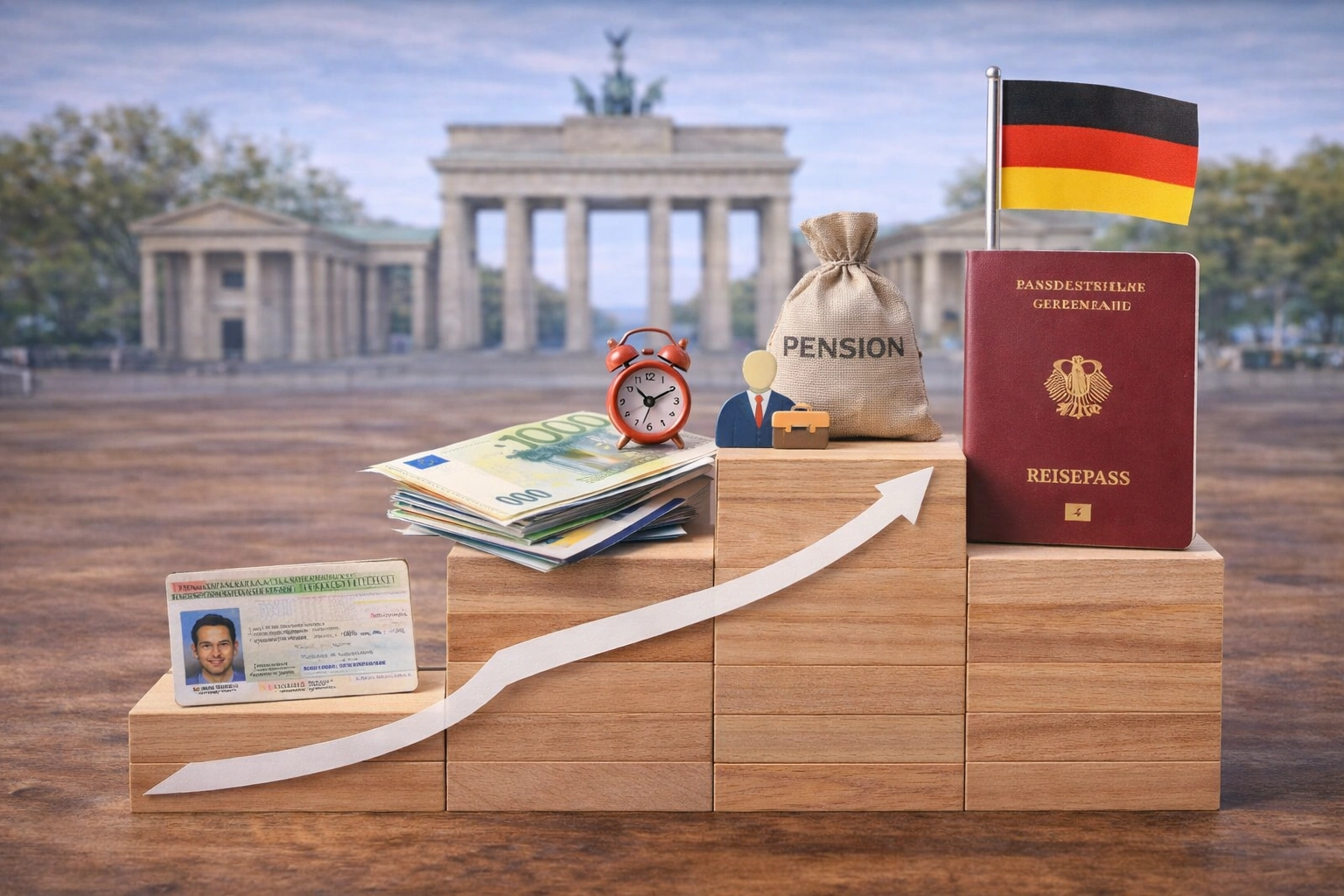
Treat your move as a system: residence title → stable track record → settlement → citizenship. The winners are the ones who keep their paperwork clean and their language improving.
Strategic Insight
How to think about “long-term” like Germany does.
Keep your registration (Anmeldung), employment, insurance, and payslips consistent, these become settlement and citizenship evidence.
German reduces bureaucracy friction and can materially shorten settlement timelines on certain routes (e.g., Blue Card).
Income stability, pension months, housing, insurance, and integration proof. Missing one bucket can delay everything.
Availability at Ausländerbehörde can be the real bottleneck. Plan renewals early and keep a digital document folder ready.
The 3-Stage Long-Term Pathway
A realistic model: entry → settlement → citizenship (with family and career stability in parallel).
1. Arrival & Career
Years 0–2
Secure your residence title (e.g., study, training, employment). Then stabilise your foundation: address registration, health insurance coverage, bank and tax setup, and a predictable employment record.
- Residence title aligned to your real activity (study/training/work).
- Continuous registration and clean paperwork trail (letters, renewals, contracts).
- Language plan that progresses, not “starts later”.
2. Permanent Residence
Years ~2–5 (route-dependent)
Transition to a settlement permit (Niederlassungserlaubnis) when eligible. This is where pension contributions, stable income, housing, and integration proof become decisive.
- Stable livelihood: income supports your life without dependency.
- Pension months tracked and documented (statutory contributions are key evidence).
- Integration proof: language + basic civic knowledge.
3. Citizenship
Year 5+
Naturalisation is the final step. The standard timeline is five years with proven integration. Dual citizenship is allowed in principle under the modern framework, but long-term success depends on having a clean, consistent record.
- Documented lawful residence and stable integration over time.
- Language and civic knowledge requirements met with evidence.
- Long-term planning: family, career continuity, and compliance culture.
Important nuance
Timelines vary by route. EU Blue Card holders can often qualify for settlement faster (e.g., 27 months with A1 German or 21 months with B1), while the general settlement permit path often targets 5 years with ~60 months of pension contributions. Always plan with buffers for appointment lead times and document verification.
Your Residence Title Is a Contract With the System
In Germany, your rights and next steps depend on the precise legal basis of your residence.
Many people treat “visa” as a single thing. In practice, Germany works with specific residence titles (Aufenthaltstitel), each with defined rights, constraints, and upgrade paths. The residence title determines whether you can change employers, work part-time, bring family, start a business, or move toward settlement.
Your goal is to avoid “status friction”: situations where your life moves faster than your residence permissions. Status friction is what creates stress, job changes delayed, family plans postponed, travel interrupted, or renewals becoming risky.
What people often miss (and pay for later)
- Restriction clauses: Some titles tie you to a job/employer/sector. Read the Zusatzblatt and conditions.
- Renewal timing: Don’t wait for expiry, appointments and document checks can take months.
- Registration consistency: Gaps in address registration or unclear timelines create credibility issues.
- Proof culture: Keep a “life folder” (contracts, payslips, insurance letters, rent contract, certificates).
Study
Strong long-term upside, but you must plan the transition: graduation → job search → qualified work → settlement path.
Vocational Training (Ausbildung)
“Earn & learn” integration route. Outcomes improve with strong German and consistent performance evidence.
Employment (incl. Blue Card)
Fastest route to long-term stability when your qualification, salary, and role-fit match the legal thresholds.
Role Changes
Promotions and employer changes are normal, but your title must allow it. Plan changes early to avoid “permission lag”.
Niederlassungserlaubnis: The “Stability Upgrade”
Permanent residence is not just a status, it reduces uncertainty across housing, career mobility, and family planning.
The settlement permit (Niederlassungserlaubnis) is Germany’s key long-term milestone. It generally expects: a stable livelihood, proven integration, and pension contributions. Many people focus on the headline months (e.g., 60), but what matters is your ability to document the full picture cleanly.
Think of settlement as a risk assessment: “Is this person established enough that Germany can grant indefinite permission?” If your file is organised, complete, and consistent, the process becomes significantly smoother.
Chancenkarte (Opportunity Card)
A points-based residence permit enabling structured job search without prior employment.
- Eligibility assessed on qualifications, language skills, experience, age, and Germany-related ties.
- No job guarantee; permit allows time-bound, lawful residence solely for employment searching.
- Limited work permissions may apply, but primary purpose remains securing qualifying employment.
- Chancenkarte time typically does not count toward settlement without permit conversion.
- Once employed, applicants must transition to skilled worker or Blue Card permits.
Stable Livelihood
Your income must support your living costs reliably. Payslips, contracts, and clean employment history matter.
Pension Contributions
The “months” requirement is often decisive. Track your Rentenversicherung history and keep records accessible.
German + Integration Proof
Language and basic legal/social knowledge reduce “integration risk” and accelerate outcomes.
Housing & Records
Proper registration, stable address history, and clean documentation prevent unnecessary delays.
Practical rule
If you want settlement later, behave like you are being audited now: keep every letter, keep clean employment timelines, and keep language progressing. When the time comes, you submit a complete, coherent file, not a “search mission”.
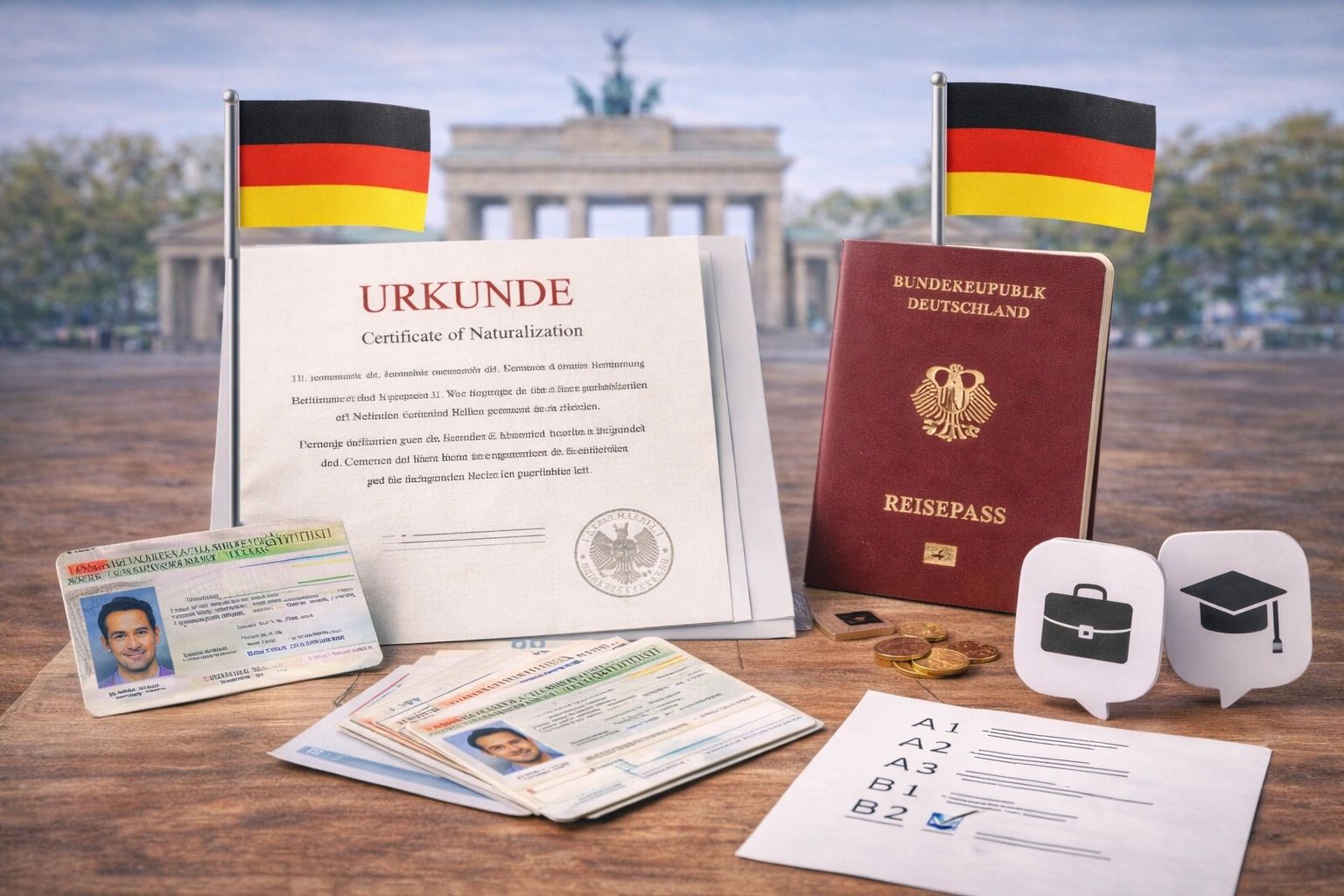
Citizenship Is the Outcome of Consistency
Germany’s naturalisation logic: lawful residence + integration + credibility.
German citizenship is not meant as a “quick passport”, it is recognition that a person has integrated successfully over time. The baseline has become more attractive: dual citizenship is allowed in principle, and the standard naturalisation timeline is five years. But rules can change, and faster “exceptional” tracks may be tightened over time, plan on the stable baseline.
In practical terms, the strongest citizenship files show a clear narrative: stable work or study-to-work transition, clean registrations, language progress, and evidence of integration into everyday systems. Your file should look boring, in the best way.
- Lawful residence history
- Language & integration proof
- Stable livelihood
- Clean compliance record
Naturalisation is paperwork-heavy. The best advantage is a well-maintained “evidence archive” built across years: contracts, payslips, address history, insurance and pension records, language certificates, and official letters.
Family Reunification Works Best When Your Base Is Strong
Germany supports family life, but it is evidence-driven: housing, income, insurance, and documentation.
Many families plan emotionally (“we will bring family soon”) without planning systemically. Family reunification typically depends on your status and your ability to show stable capacity: adequate housing, health insurance coverage, and sufficient income to support the household. The faster your life becomes document-ready, the smoother family planning becomes.
Practical tip: treat family planning and settlement planning as parallel projects. The evidence overlaps heavily: stable employment, rent contract, registration history, insurance, and clean timelines.
The “Family Readiness” checklist (practical)
- Housing readiness: rent contract + space that meets practical requirements; clean registration.
- Income stability: enough disposable income after rent, insurance, and essentials.
- Insurance clarity: understand who is covered and how (especially when life status changes).
- Paperwork discipline: keep certified copies and translations ready where applicable.
Documents Multiply
Once family enters the picture, every system needs updates: registration, insurance, tax class, benefits eligibility, and contracts.
Timing Matters
Appointment lead times can be long. Plan renewals and applications with buffers, especially around travel and life events.
Integration Gets Easier
Once your base is stable, family integration becomes a system: language, social networks, schooling, and routine.
Entrepreneurship Is Designed for Sustainability, Not Speculation
Germany supports business-building, but within structured legal and compliance frameworks.
Many newcomers assume entrepreneurship is “unregulated freedom”. Germany is the opposite: it is predictable because it is structured. Legal entities, accounting obligations, insurance, and registrations are clear. The upside is credibility, once you are compliant, partners and institutions take you seriously.
The best long-term strategy is to build a credible operating model: clear service scope, clean contracts, professional bookkeeping, and compliance habits from day one. This isn’t glamour, it’s what enables growth and long-term residence stability.
What successful founders do differently
- Separate personal vs business: professional accounts, contracts, and records from day one.
- Operate “audit-ready”: invoices, tax logic, and documentation are always clean.
- Focus on long-term credibility: the German market rewards reliability and process discipline.

Even if you plan entrepreneurship later, start now by building “German credibility”: language progress, clean contracts, and a disciplined record of compliance.
Your Long-Term File: What to Track From Day One
This is how you avoid future delays: build an evidence archive while you live your life.
Your “Evidence Folder”
Keep a structured archive: residence letters, Zusatzblatt, contracts, payslips, insurance proofs, rent contract, registration history, pension record, certificates, and language documents.
Track “Months That Matter”
Pension contributions, residence continuity, and language progress are the hidden clocks of the system. Track them as you would track money.
The 10-point long-term checklist
Frequently Asked Questions
Nuanced answers to common long-term planning questions.