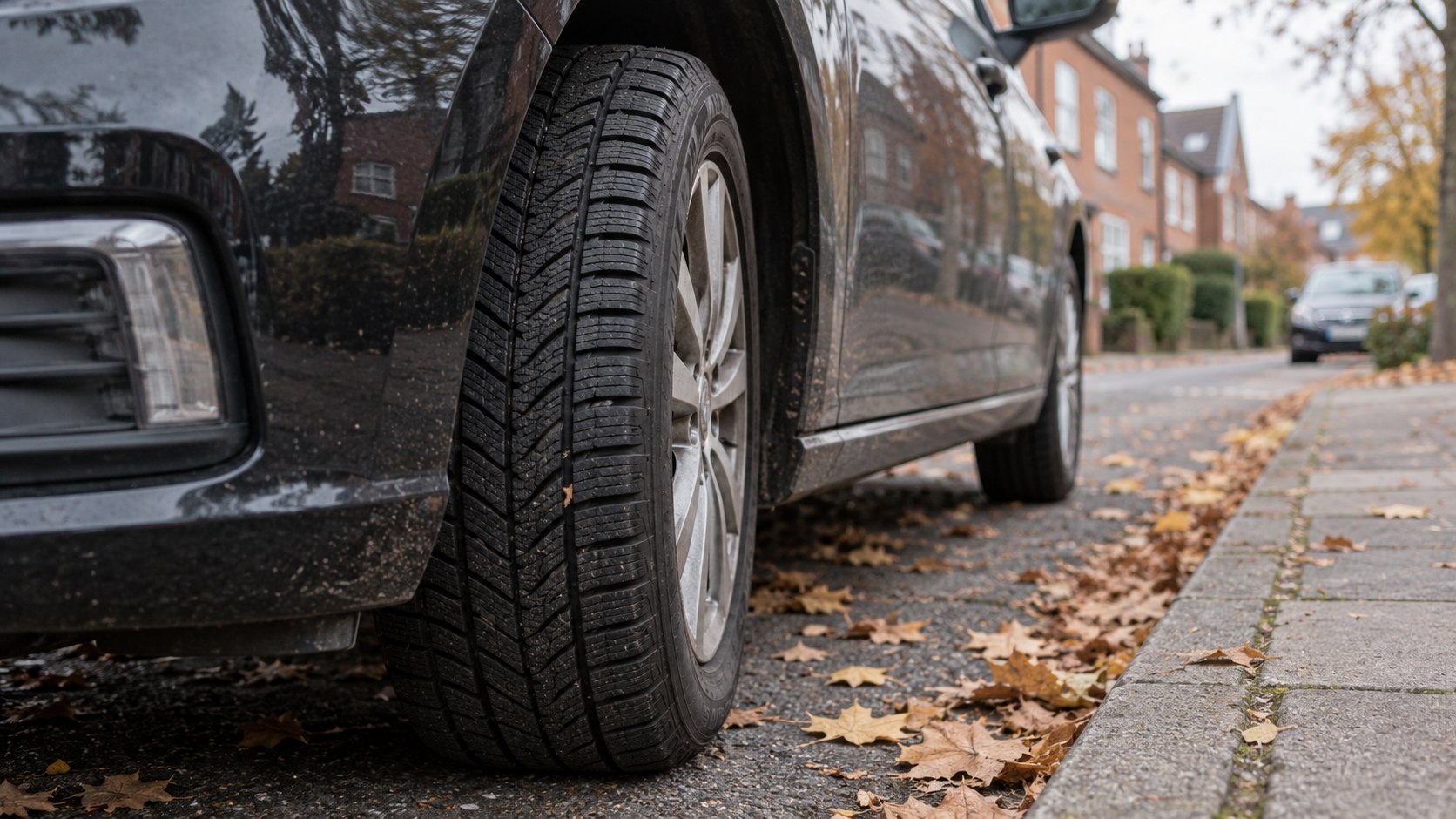
If you drive in Germany, you may hear a familiar phrase: “Winter tyres from October to Easter.” The saying is useful as a seasonal reminder, but it is not the legal rule. Germany has a situative Winterreifenpflicht, a situational winter tyre obligation. Winter appropriate tyres are required when driving in specific wintry road conditions, not simply because the calendar says October. Germany's Federal Ministry of Transport restated this in guidance dated 1 October 2026, and ADAC explained the rules again on 8 October. [1][2]
When are winter tyres legally required?
Under §2(3a) of the German Road Traffic Regulations (StVO), affected vehicles must be equipped with suitable tyres when the roads have conditions such as:
- black ice (Glatteis);
- snow covered ice (Schneeglätte);
- slush (Schneematsch);
- ice related slipperiness (Eisglätte);
- frost related slipperiness (Reifglätte).
For ordinary passenger cars, the obligation generally applies to tyres on all wheels. The rules are different for certain buses and heavy commercial vehicles, and some vehicle categories have exemptions. [1]
Why “October to Easter” is only a rule of thumb
German weather differs significantly between regions and years. A mild day in October may not produce conditions that trigger the winter tyre rule. Conversely, a snowy April morning can. The practical approach is to fit appropriate tyres well before the first forecast ice or snow, because waiting until conditions deteriorate creates a safety and legal risk.
A tyre change appointment is not proof that driving on unsuitable tyres in ice is allowed in the meantime.
The Alpine symbol: what to look for
Suitable winter tyres must carry the Alpine symbol: a mountain with three peaks containing a snowflake, also called the 3PMSF marking. The marking is usually visible on the tyre sidewall. It is the crucial label to check, not the word “winter” on a seller's invoice.
Since 1 October 2024, tyres marked only M+S (mud and snow), without the Alpine symbol, no longer qualify for the German winter tyre requirement in wintry conditions. This was not introduced as a new October 2026 rule. [2]
Can you use all season tyres in Germany?
Yes, all season tyres can comply if they carry the Alpine symbol and otherwise meet the relevant standards. But legal eligibility and real world performance are different questions. An all season tyre that meets the rule may still have different snow and ice handling from a dedicated winter tyre.
If you frequently drive in mountainous regions or places with heavy snow, assess suitability with the expected conditions in mind. [3]
What about tread depth?
The statutory minimum tread depth is 1.6 mm. ADAC recommends at least 4 mm for winter performance. A tyre can therefore remain technically above the legal minimum and still provide reduced grip on snow and slush. [2][3]
Also check tyre pressure, visible damage, age and the correct size for the vehicle. The condition of the tyre matters as much as the seasonal designation.
What fines apply?
According to ADAC, driving without the required winter tyres in wintry conditions can result in a €60 fine and a point on the driving licence register. If other traffic is obstructed, the fine can rise to €80. A vehicle keeper can also face consequences for allowing use with inappropriate tyres. Penalties can escalate with additional circumstances. [2]
For an international driver, a fine is only part of the issue. A collision or insurance dispute can be far more consequential. Avoid reading the law as permission to drive with summer tyres until the first police stop.
Driving a rental car in Germany
Many newcomers rent a car for airport transfers, job interviews or weekend trips. A car hired in Germany is not automatically guaranteed to have suitable tyres for every route and forecast condition.
Before accepting the keys:
- Ask whether winter compatible tyres are fitted.
- Check the Alpine symbol yourself.
- Inspect the visible tread and condition.
- Confirm whether snow chains are needed for your planned mountain route.
- Ask the company how roadside assistance works during winter weather.
Driving into Austria, Switzerland or another neighbouring country may expose you to different national requirements. Do not assume Germany's rule applies unchanged across borders.
What should a new resident buy?
If you do mostly urban driving in mild climates, a properly rated all season tyre may be an option. If you often drive on snowy country roads, dedicated winter tyres may be more appropriate. Consider typical weather, mileage, tyre tests, storage and cost rather than choosing only on convenience.
You can also use public transport for journeys during severe weather. Having a car does not mean every drive is necessary.
Frequently asked questions
Must I switch tyres on 1 October?
No fixed nationwide calendar date triggers the legal duty. Wintry road conditions do.
Are M+S tyres still legal in winter?
M+S only tyres without the Alpine symbol do not satisfy the winter tyre rule in qualifying wintry conditions.
Are all season tyres enough?
They can be, if they have the Alpine symbol and meet the relevant requirements.
Does the rule apply to every car in Germany?
There are vehicle specific details and exemptions. The broad explanation here concerns ordinary passenger cars; commercial operators should check their vehicle category.
WhyGermany takeaway
Check the weather, not just the month. The most useful winter driving habit for newcomers is to verify the Alpine symbol, inspect tyre condition and prepare early. The October to Easter saying may help you remember the season, but the law is built around road conditions.
Sources
- Federal Ministry of Transport, 1 October 2026: Winter tyre obligation
- ADAC, 8 October 2026: Winter tyres and fines
- ADAC: All season tyres in winter
Last fact checked: 17 October 2026.