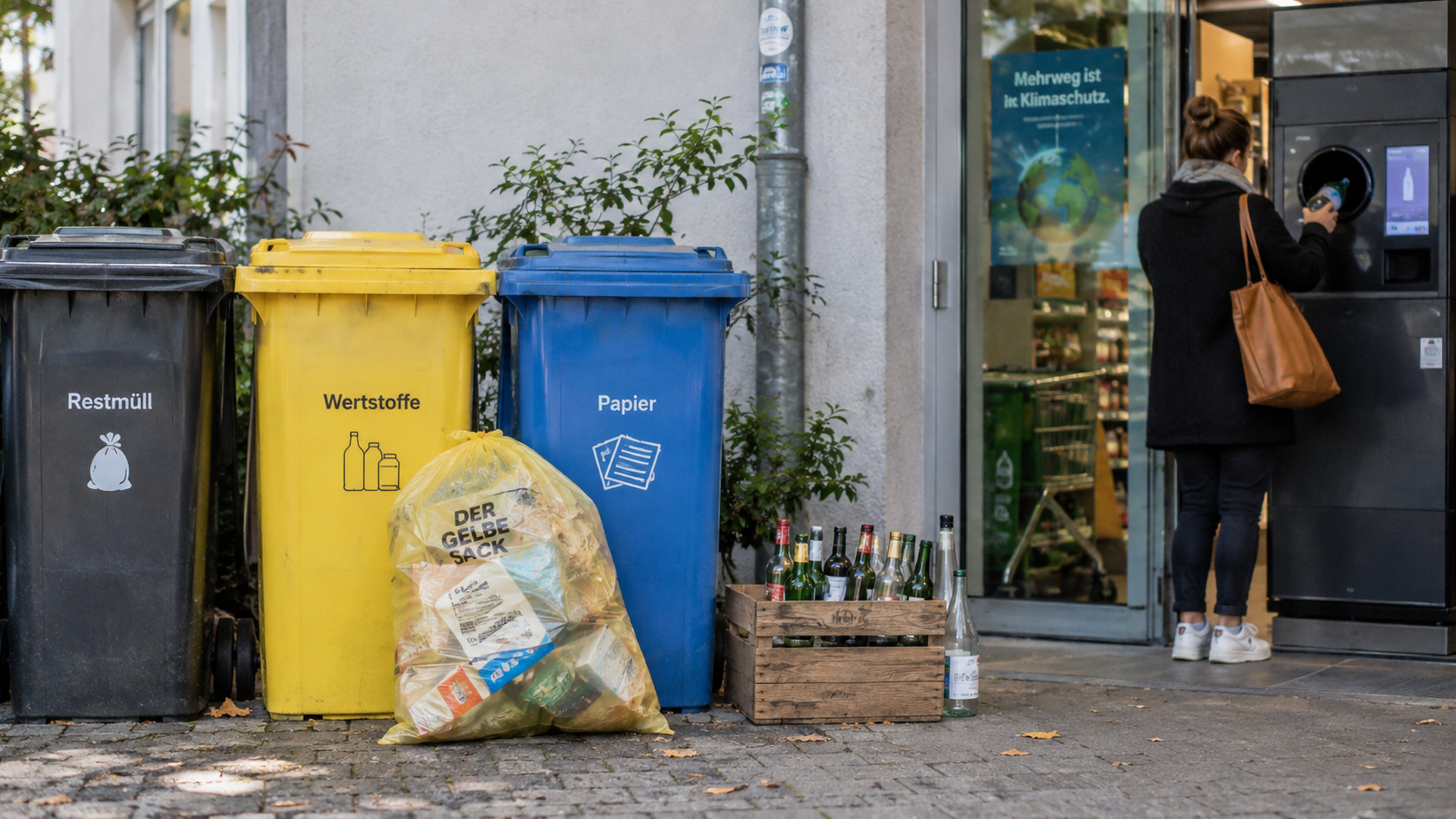
Quick answer: Waste sorting in Germany, or Mülltrennung, is part of everyday life. Most households separate packaging, paper, glass, organic waste and residual waste, while many bottles and cans are returned through the Pfand deposit system. New EU packaging rules began applying in August 2026, but newcomers do not need to relearn Germany's household bin system overnight.
How does waste sorting work in Germany?
Anyone moving to Germany quickly discovers that throwing something away can require more thought than expected.
Yellow bin? Paper? Glass? Biomüll? Restmüll? Pfand machine?
Germany's waste system is built around separating different materials so they can be recycled or treated appropriately.
The exact local collection system can vary between municipalities, but the main categories are broadly familiar across Germany.
What goes in the yellow bin or Gelber Sack?
The Gelbe Tonne or Gelber Sack is generally used for eligible lightweight sales packaging made from materials such as plastic, metal and composite materials.
Examples can include:
- yoghurt cups
- plastic packaging
- food tins
- aluminium packaging
- beverage cartons
- other eligible lightweight packaging.
It is primarily a packaging collection system, not a general plastic-waste bin.
Local waste authorities may provide more precise instructions, so check the rules in your municipality.
What goes in the paper bin?
Paper and cardboard usually belong in the paper collection system, often a blue bin.
Typical examples include:
- newspapers
- cardboard boxes
- paper packaging
- office paper
- magazines.
Food-contaminated or heavily soiled paper may need different disposal.
How do you recycle glass in Germany?
Glass packaging is often taken to neighbourhood Altglascontainer.
You may need to separate glass by colour:
- white
- brown
- green.
Not every glass object belongs in these containers. Drinking glasses, ceramics, mirrors and window glass may need different disposal routes.
Many municipalities also restrict the hours when glass containers may be used because dropping bottles creates noise.
What is the Biotonne?
The Biotonne is used for eligible organic waste.
Depending on local rules, this may include:
- fruit and vegetable scraps
- coffee grounds
- tea
- certain food waste
- garden waste.
Rules differ between municipalities, particularly for items such as cooked food, meat or compostable bags.
What is Restmüll?
Restmüll is residual household waste that does not belong in the recyclable or organic streams.
The purpose of Mülltrennung is to keep recyclable materials out of residual waste wherever possible.
How does Pfand work in Germany?
Pfand is Germany's deposit system for many beverage containers.
When you purchase an eligible bottle or can, the price includes a deposit. You can return the container, often through a Pfandautomat in a supermarket, and receive the deposit back.
For newcomers, the useful habit is simple:
Before throwing away a bottle or can, check whether it carries a Pfand symbol.
What changed under Germany's 2026 packaging rules?
On 12 August 2026, the EU Packaging and Packaging Waste Regulation began applying across the European Union, including Germany.
The new framework introduces and phases in requirements relating to:
- recyclability
- recycled content
- packaging reduction
- reuse
- producer responsibility
- hazardous substances
- clearer information for consumers.
Many of the most visible requirements will be introduced gradually over the coming years.
Do households need to sort waste differently after August 2026?
Not simply because the new packaging framework started applying.
Germany's familiar household systems continue.
That means newcomers should still learn their local rules for:
- Gelbe Tonne or Gelber Sack
- paper
- glass
- Biotonne
- Restmüll
- Pfand returns.
The bigger immediate regulatory burden falls on businesses placing packaging on the market rather than on households.
What changed immediately for food packaging?
The new framework includes limits relating to certain PFAS chemicals in food-contact packaging.
This is designed to improve environmental and consumer protection.
For ordinary residents, however, the practical household routine remains largely familiar.
Will packaging become easier to understand?
One objective of the European framework is clearer, more standardised consumer information about how packaging should be sorted.
But do not expect every package in a German supermarket to look completely different immediately. Many labelling and sustainability measures have later implementation dates.
Common Mülltrennung mistakes newcomers make
Treating the yellow bin as a general plastic bin
The yellow system is generally about eligible packaging, not every plastic object.
Throwing Pfand bottles away
Check the container before using the rubbish bin. It may be worth a refundable deposit.
Putting the wrong glass into Altglas
Ceramics, drinking glasses and window glass are not automatically equivalent to glass packaging.
Assuming all cities have identical rules
Waste collection is organised locally. Details can vary by municipality.
A useful question when you move in
Ask your landlord, Hausverwaltung or neighbour:
Welche Tonne ist für welchen Müll?
Which bin is for which rubbish?
Also ask:
- Where are the nearest glass containers?
- When are the bins collected?
- Is there a separate Biotonne?
- Where does bulky waste go?
- How are batteries and electronics disposed of?
WhyGermany takeaway
Germany's packaging rules changed substantially in August 2026, but newcomers do not need to relearn household waste sorting overnight.
The familiar yellow-bin, paper, glass, organic-waste and Pfand systems remain central to daily life.
Learning Mülltrennung is simply part of settling into Germany.
Sources
- European Commission – new EU packaging rules
- German Environment Agency – packaging guidance
- German Environment Ministry – European packaging law
Last reviewed: September 2026.