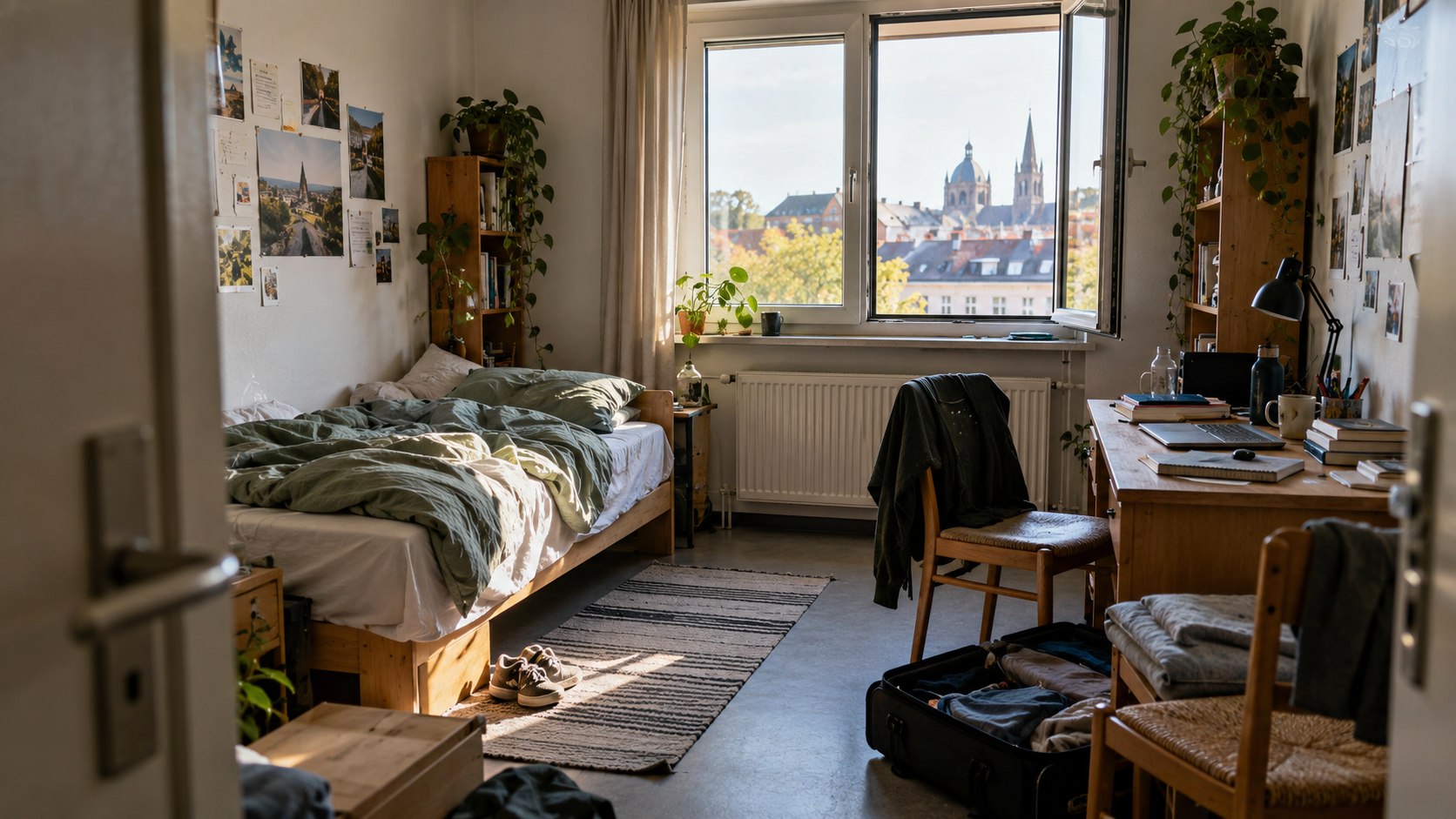
Germany can offer an excellent academic education, but an admission letter does not come with a guaranteed set of keys. In September 2026, the German Student Services Association (Deutsches Studierendenwerk, DSW) reported that 106,045 students were on waiting lists for student services accommodation. The snapshot was taken on 15 September 2026. Separately, research on advertised shared flat rooms found a Germany wide, student weighted figure of around €510 per month for winter semester 2026/27. These are two different measures, but together they explain why accommodation deserves as much planning as enrolment. [1][2]
What does the 106,045 figure actually mean?
The DSW surveyed its member student services organisations (Studierendenwerke). The number represents students on their waiting lists, not all students looking for housing in Germany and not a count of all available rooms. It should not be interpreted as 106,045 additional vacant homes that must be built immediately. Nonetheless, it demonstrates substantial demand for comparatively affordable student housing.
The pressure varies considerably by location. The DSW counted 11,170 students on the list for Aachen and 10,812 at Munich/Oberbayern; Nordrhein Westfalen and Bavaria had the largest state level waiting list counts. These figures tell prospective students something practical: university location changes the housing experience. [1]
How much does a WG room cost in Germany?
A Wohngemeinschaft (WG) is a shared apartment in which residents generally rent separate rooms and share a kitchen or bathroom. A September 2026 analysis by the Moses Mendelssohn Institute and WG Gesucht assessed advertised WG rents in 90 higher education locations.
| Location | Indicative room rent in the study |
|---|---|
| Germany wide student weighted figure | €510/month |
| Munich | €850/month |
| Berlin | €650/month |
| Hamburg | €650/month |
| Cologne | €640/month |
| Frankfurt am Main | €630/month |
These are advertised room rent indicators, not binding citywide rent caps or what every individual tenant pays. Conditions, included utilities, room sizes and neighbourhoods differ. A €510 national figure must never be treated as a reliable budget for Munich. [2]
Dormitory, WG or temporary room: which should you choose?
Student residence (Wohnheim): Often relatively affordable and close to other students. Applications and allocation are administered by the relevant organisation; a university admission does not mean allocation is automatic. Apply as soon as the residence provider permits.
WG room: Can provide a social entry point, but landlords and flatmates commonly screen applicants. Prepare a short introduction and be ready for interviews or video calls. Clarify whether the rent is Warmmiete (including specified service charges) or Kaltmiete (base rent).
Temporary accommodation: A hostel, serviced apartment or short let may help for the first weeks. But confirm whether it permits formal address registration (Anmeldung). Many holiday style accommodations do not. A cheap room that does not support registration can create avoidable administrative problems.
Start before the visa is issued
A realistic accommodation plan runs in parallel with the admissions process. Find the local Studierendenwerk, read its eligibility and application rules, and monitor suitable WGs. Investigate nearby towns with a feasible train or tram commute instead of focusing exclusively on the university postcode.
If you are considering several universities, compare housing as part of the choice. A programme in an expensive city can become less affordable even if the tuition fees are low.
How to avoid rental scams
Germany's federal official newcomer portal cautions against demands for rent or a deposit before a valid rental contract and possession or keys. Be suspicious of an owner who says they are abroad, refuses a viewing or live video inspection, demands an urgent transfer to a personal account, or offers an unrealistically attractive room in a city with high demand. [3]
Before paying, verify the landlord or provider, read the agreement, inspect the property or arrange a trustworthy viewing, and establish what proof of residence will be given. Keep all communications and receipts.
For ordinary German residential leases, §551 BGB generally caps a cash security deposit at three months' basic rent excluding stated service charges. When a cash deposit is due, the tenant has a right to pay it in three monthly instalments. Specific accommodation arrangements can have special rules, so read the agreement carefully. [4]
What to ask before signing
- Is Anmeldung possible, and will the provider issue a Wohnungsgeberbestätigung?
- Is the price Warmmiete or Kaltmiete? Which costs are extra?
- What is the deposit, and when is it due?
- Is the room furnished? Is the kitchen shared?
- Are there fixed term restrictions, quiet hours or guest rules?
- How long is the commute to lectures and, if relevant, part time work?
- What are the cancellation terms if the visa is delayed?
Frequently asked questions
Does university admission guarantee a student dormitory?
No. University admission and residence allocation are separate processes. Confirm the procedure with the relevant Studierendenwerk.
Can international students apply for dorm rooms?
Many can, subject to individual eligibility, deadlines and capacity. There is no single nationwide allocation rule for every provider.
Is €510 enough for rent in Germany?
It is a useful broad indicator from one market study, not a guarantee. Budget according to the particular city, room and contract.
Can I rent before receiving a German SCHUFA record?
Sometimes. Landlords may accept a contract of employment, bank reference, guarantor or alternative evidence. Ask what each landlord accepts.
WhyGermany takeaway
Choose the study location and the housing plan together. The best offer is not automatically the one with the most famous city name. Plan for a waiting list, understand WG costs, protect yourself against deposit scams and confirm your ability to register at the address. Housing is not an administrative detail after admission; it is part of the decision to study abroad.
Sources
- Deutsches Studierendenwerk, 25 September 2026: 106,045 on housing waiting lists
- Deutsches Studierendenwerk, 17 September 2026: WG room cost study
- Make it in Germany: Housing and registration
- German Civil Code, §551: Security deposits
Last fact checked: 17 October 2026.