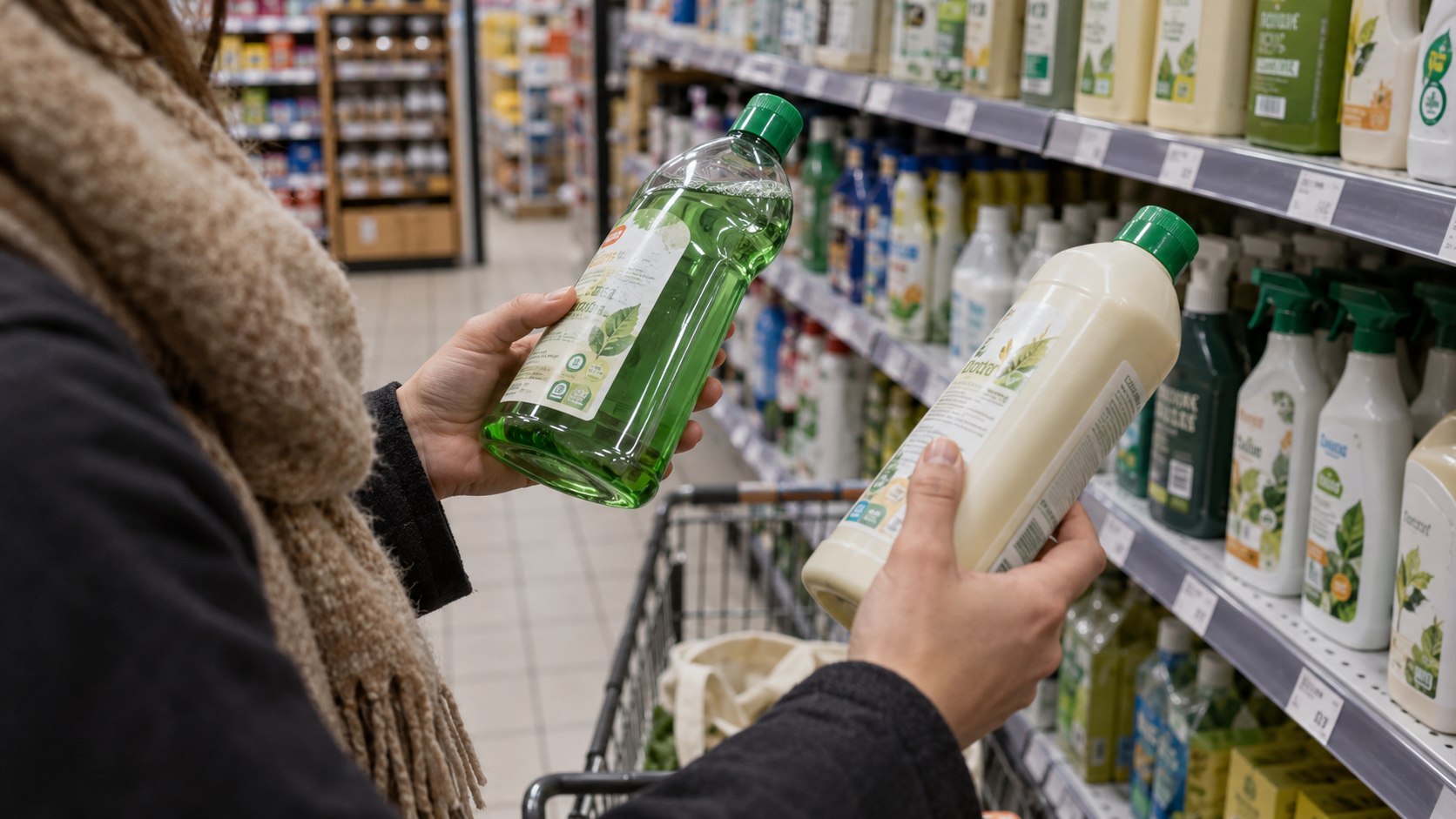
Walk through a German supermarket and you will find products advertised as nachhaltig (sustainable), umweltfreundlich (environmentally friendly), klimaneutral (climate neutral) or recycelbar (recyclable). These words sound reassuring, but they can be vague. Are they about the entire product, one ingredient, the packaging or a company's future target?
From 27 September 2026, stricter rules against misleading environmental claims started applying in Germany. They implement the EU's Empowering Consumers for the Green Transition framework, commonly called EmpCo. Germany's Environment Ministry and Federal Environment Agency explained the practical purpose in September: claims must be more reliable, substantiated and easier for consumers to examine. [1][2]
What is greenwashing?
Greenwashing happens when a company gives customers a misleading impression about the environmental qualities of a product, service or business. It might involve a broad claim that cannot be supported, a green logo that resembles independent certification, or promotion of a minor environmental attribute as if it proved the entire product is sustainable.
Not every green claim is false. The problem is the gap between the impression created and the evidence available.
What changed on 27 September 2026?
The revised EU consumer protection framework addresses a range of misleading practices, including generic environmental statements, sustainability labels and certain climate related claims. Germany transposed the relevant directive earlier in 2026, with application from late September. [2][3]
These rules aim to make it harder to sell products simply by using vague eco language without the required substantiation. They also place emphasis on credible labels that satisfy recognised standards.
This does not mean every product marketed as sustainable is suddenly banned. Legitimate claims backed by appropriate evidence remain possible. The restrictions depend on the exact wording and circumstances.
“Eco friendly” does not automatically mean everything is green
Suppose a washing up liquid has a bottle made from some recycled material. That might be a real environmental benefit. But using that single fact to suggest that the entire product is environmentally harmless can mislead customers.
The same issue applies to a shoe marketed as sustainable because the laces contain recycled fibres. Ask whether the claim relates to the whole shoe, the material, the packaging or a specific stage in production.
When shopping, look for precise statements such as a named percentage of recycled content or an identifiable, independently assessed product attribute. Specific evidence is more useful than green coloured branding.
What about “climate neutral” labels?
Claims about climate neutrality can be especially difficult to evaluate. A company may have reduced emissions, purchased carbon credits, supported climate projects or used a combination of approaches. These are not equivalent.
New consumer protection rules restrict misleading representations connected with greenhouse gas offsetting. Do not assume that a climate neutral looking logo means a product's manufacturing and transport generated no emissions.
Look for a transparent explanation of the product's actual emissions and the basis for any claim.
Are sustainability seals trustworthy?
A certification mark should provide more information than a leaf icon. In Germany, Blauer Engel (Blue Angel) is a well established environmental label that the German Environment Ministry presents as an example of credible guidance under the new framework. [1]
A label is more useful when you can identify:
- who operates the scheme;
- what criteria apply;
- whether evaluation is independent;
- whether the criteria relate to the whole product or a specific feature;
- how often the certification is checked.
Not every trustworthy label has to look official or German, and not every self created company symbol is proof of wrongdoing. But a logo without understandable criteria should prompt more questions.
Does this affect online shopping?
Yes. Environmental claims can appear on websites, product listings, social media advertisements, packaging or promotional material. Read the detailed description rather than relying only on the headline and badge.
If a seller says “100% sustainable,” ask how that is measured. If it uses a guarantee or durability promise, check the terms in writing. Preserve screenshots if a claim influences an expensive purchase.
Why is this useful for newcomers?
German consumer shopping culture can be unfamiliar. A new resident may trust a German language environmental slogan without understanding what is promised. The new rules make that distinction more important, and provide a reason to examine the label rather than simply translate the word.
The key vocabulary is worth learning:
| German phrase | English meaning | Question to ask |
|---|---|---|
| nachhaltig | sustainable | In which measurable respect? |
| umweltfreundlich | environmentally friendly | Compared with what alternative? |
| klimaneutral | climate neutral | What emissions and measures are included? |
| recycelbar | recyclable | Is recycling technically and practically available? |
| Gütesiegel | quality/certification seal | Who verifies it? |
Frequently asked questions
Were all eco labels banned in Germany in September 2026?
No. The rules focus on misleading claims and insufficiently credible sustainability labelling, not truthful environmental information.
Can a product still say “recyclable”?
A claim should be accurate and substantiated under the relevant legal requirements. Whether it is misleading depends on what consumers are led to believe.
Is the Blue Angel an official German environmental label?
Yes. Blauer Engel is a long established environmental label backed by German public institutions.
Does the law guarantee that all green claims are now true?
No law eliminates deceptive marketing instantly. Consumers should still examine evidence and report potentially misleading claims through appropriate consumer protection channels.
WhyGermany takeaway
An attractive green package is not evidence by itself. From September 2026, Germany applies stricter consumer protections against misleading environmental advertising. Read the exact claim, check the supporting evidence and distinguish independent certification from a marketing logo.
Sources
- German Environment Ministry, 25 September 2026: New rules against greenwashing
- Federal Environment Agency, 25 September 2026: Protection against greenwashing
- European Consumer Centre Germany: EU rules from September 2026
Last fact checked: 17 October 2026.