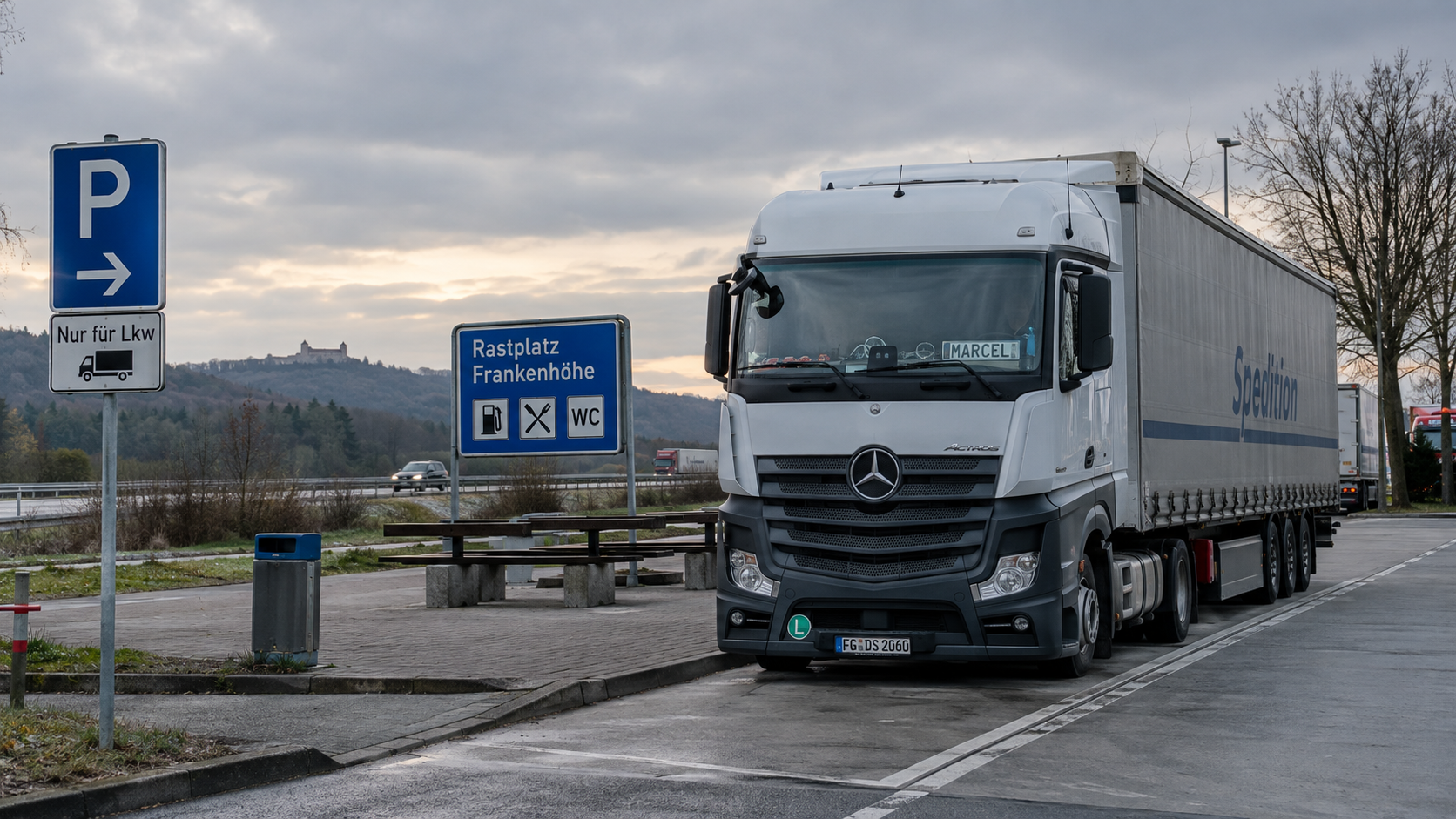
Quick answer: Germany generally restricts commercial goods transport by trucks over 7.5 tonnes and trucks with trailers on Sundays and public holidays from 00:00 to 22:00. There are statutory exceptions, and Germany also has separate summer Saturday restrictions on certain roads. In August 2026, several federal states temporarily relaxed parts of the Sunday ban because low river levels disrupted inland freight.
What is the Sunday truck ban in Germany?
Germany has a nationwide Sunday and public-holiday driving restriction for certain heavy commercial vehicles. The rule generally covers commercial goods transport using trucks above 7.5 tonnes and trucks with trailers.
For international truck drivers, logistics workers and dispatchers, this is important because Germany's operating rules can differ significantly from countries where commercial road freight routinely moves seven days a week.
The standard restriction generally runs from 00:00 until 22:00 on Sundays and public holidays.
Which trucks are affected?
The restriction generally applies to:
- commercial goods transport using trucks with a permissible total weight above 7.5 tonnes
- trucks with trailers used for commercial goods transport.
The exact application can depend on the vehicle, journey and cargo, so professional drivers should verify the current official rule before departure.
Which transports may be exempt?
Germany provides exceptions for specified types of freight and transport operations. These can include certain fresh-food transports and some combined road-rail or road-port movements.
Drivers should never assume that carrying time-sensitive goods automatically creates an exemption. The exemption needs to fit the legal category and, where required, the correct documents should be carried.
Does Germany also have a Saturday truck ban?
Yes, Germany has a separate summer holiday driving restriction.
Between 1 July and 31 August, affected heavy goods vehicles are prohibited on specified sections of autobahns and federal roads on Saturdays between 07:00 and 20:00.
This is separate from the normal Sunday and public-holiday restriction.
A professional driver may therefore need to check:
- Sunday/public-holiday restrictions
- the summer Saturday restriction
- route-specific restrictions
- federal-state exemptions
- cargo-specific exceptions.
What changed because of low river levels in 2026?
In August 2026, unusually low water levels disrupted freight movement on major German waterways.
The Rhine is one of Europe's most important inland freight corridors. Chemicals, fuels, minerals, agricultural products and industrial goods regularly move by barge.
When water levels fall, barges may need to reduce their loads or stop operating efficiently. Cargo then has to move by other modes such as road or rail.
Several German federal states therefore introduced temporary exemptions from parts of the Sunday truck restriction for freight affected by low water.
Berlin and Brandenburg, for example, announced temporary Sunday exemptions for goods that would normally be transported by inland waterways but could not be transported that way because of the low-water situation. Necessary empty journeys were also included.
Did Germany abolish the Sunday truck ban?
No.
This is the most important distinction for drivers.
The 2026 relaxations were:
- temporary
- linked to specific low-water disruption
- dependent on the federal state
- limited to qualifying journeys.
Ordinary freight journeys unrelated to the low-water situation remained subject to the normal Sunday restriction.
A driver should therefore never hear “the Sunday truck ban has been relaxed” and interpret that as permission to drive anywhere in Germany on Sunday.
Why Germany's federal system matters
Germany has 16 federal states, or Länder.
Although the core driving restriction is national, state authorities can issue exemptions in justified situations. A temporary exemption in one state may therefore not automatically apply in another.
For international logistics workers, this means route planning is also regulatory planning.
Before driving on a Sunday or public holiday, check:
- which federal states the route crosses
- whether the exemption covers the cargo
- the validity dates
- whether an empty journey is covered
- whether documentary proof is required
- whether a separate summer restriction applies.
What should foreign truck drivers check before departure?
Do not rely only on a dispatcher saying that “the ban is lifted.”
Confirm:
- Vehicle: Is your truck covered by the normal restriction?
- Cargo: Is the cargo included in an exception?
- Route: Which Länder will you enter?
- Date and time: Is the exemption currently valid?
- Documentation: Do you need freight or accompanying documents?
- Return journey: Is an empty trip also covered?
Germany Sunday truck ban: quick FAQ
Can trucks drive on Sundays in Germany?
Some can. The general restriction covers specified commercial heavy goods vehicles, while statutory and temporary exemptions exist.
What time does the Sunday truck ban end?
The standard restriction generally ends at 22:00.
Does Germany have a Saturday truck ban?
Germany has a separate summer Saturday restriction on specified routes between 1 July and 31 August.
Are the 2026 low-water exemptions permanent?
No. They were temporary measures responding to disruption in inland freight transport.
WhyGermany takeaway
Successful international mobility for professional drivers is not only about licences, Code 95, visas or driving ability.
Drivers must also understand Germany's operating rules.
Know the vehicle. Know the route. Know the rule.
Sources
- Federal Office for Logistics and Mobility – LKW driving restrictions
- Federal Ministry of Transport – holiday-period truck restrictions
- Berlin – temporary low-water exemption, August 2026
Last reviewed: September 2026.